





The End of Photoshoots? How to Generate Professional Glasses-On-Model Images Using AI (A Guide for Brands)
 Pic Copilot Team
Introduction: The Visual Crisis in Eyewear E-commerce
For decades, the eyewear industry has been held hostage by a single, expensive reality: Eyewear is incredibly difficult to photograph.
Unlike a cotton t-shirt or a leather handbag, a pair of glasses is a complex combination of reflective surfaces, transparent lenses, and intricate metal or acetate details. To sell them online, you cannot simply rely on a flat-lay photo against a white background. Data from major e-commerce platforms suggests that conversion rates increase by up to 40% when a customer sees the eyewear worn on a human face. It provides scale, context, and emotional connection.
However, for small to mid-sized eyewear brands, dropshippers, and independent designers, achieving this standard is a logistical and financial nightmare. A professional photoshoot involving models can cost anywhere from $3,000 to $10,000 per collection. You face model booking fees, studio rentals, lighting equipment costs, and weeks of post-production retouching to remove glare from the lenses.
But in 2025, the landscape shifted. The emergence of AI Virtual Model Photography has created a new paradigm. It is no longer about "Virtual Reality" or gimmicky AR filters. It is about Commercial Image Generation.
This comprehensive guide will walk you through exactly how glasses on model images are being revolutionized by AI, the technology behind it, and how you can implement this workflow to save 90% of your photography budget while increasing your catalog's diversity.
Section 1: The "Search Intent" Trap – Why You Are Looking for the Wrong Thing
Before we dive into the solution, we must address a common confusion in the industry. If you are a brand owner looking for this technology, you might be searching for terms like "virtual try on glasses" or "virtual reality eyewear."
This is a mistake.
- Virtual Try-On (AR): This is a consumer-facing tool. It uses a webcam to overlay a low-resolution 3D model onto a customer's live video feed. It is designed for speed, not fidelity. The lighting is fake, and the fit is approximate. It is a sales tool, not a content creation tool.
- Virtual Reality (VR): This refers to hardware like the Apple Vision Pro. It has nothing to do with selling acetate frames on Shopify.
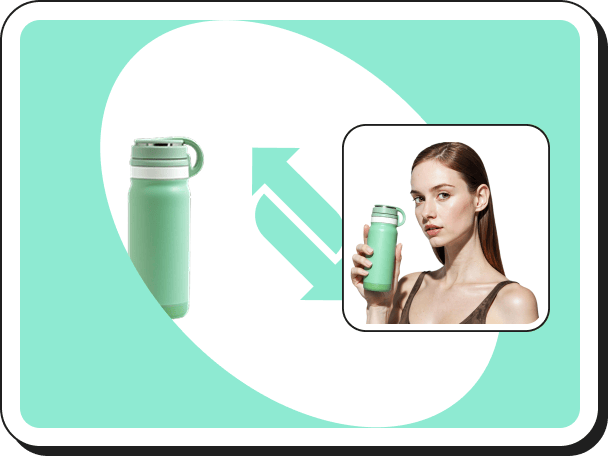
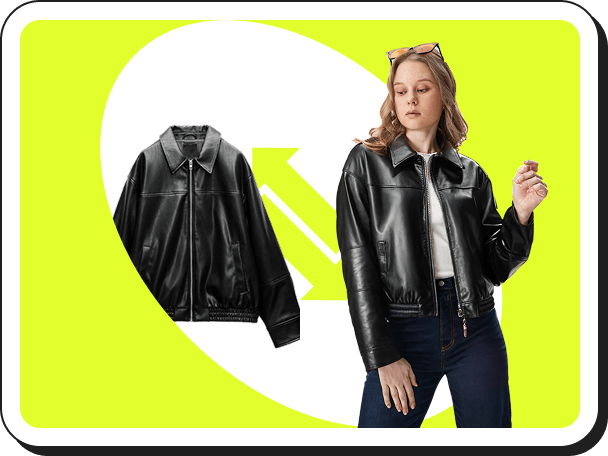
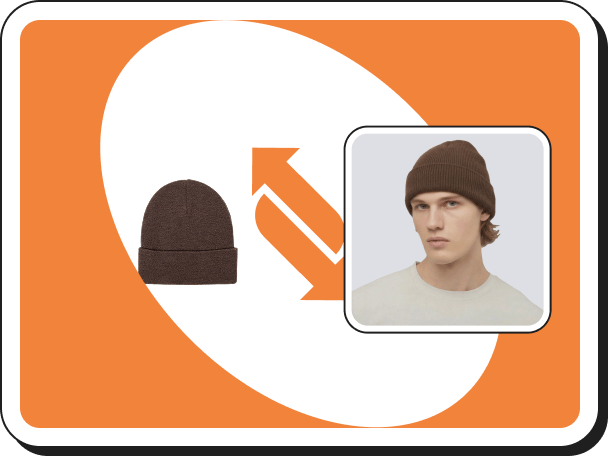
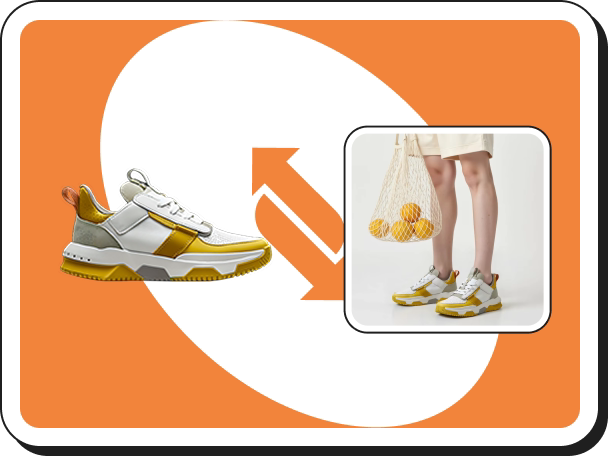
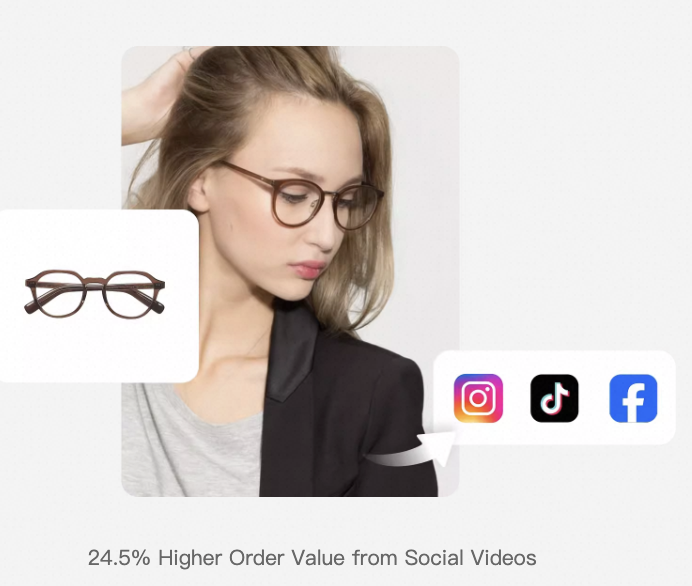
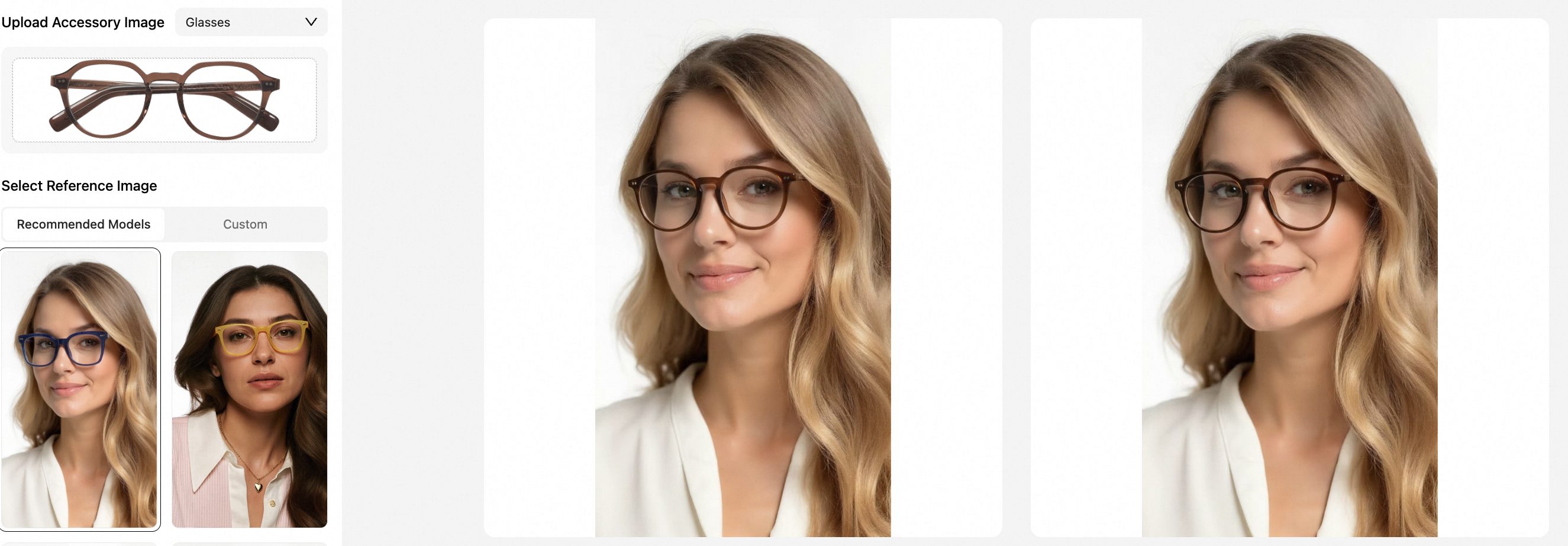
- AI Virtual Model Generation (The Solution): This is a B2B production tool. It takes a static, high-resolution photo of your product and composites it onto a photorealistic, AI-generated human model. The result is a static marketing image (JPEG/PNG) that looks exactly like a photo taken in a high-end studio.
If your goal is to create banner ads, Instagram posts, or product listing images, you are looking for AI eyewear product photography, not virtual try-on.
Section 2: The Economics of AI vs. Traditional Photography
To understand why the industry is pivoting to AI, we need to look at the hard numbers. Let's assume you are launching a new summer collection consisting of 20 SKUs (Stock Keeping Units).
Scenario A: The Traditional Photoshoot
- Model Casting: You need diversity, so you hire two models (one Male, one Female).Rate: 1,000/dayx2=2000
2,000*
- Photographer & Assistant: Day rate including equipment = $1,500.
- Studio Rental: A clean cyclorama wall studio = $800.
- Stylist/Makeup: To ensure the models look professional = $500.
- Post-Production: Retouching 20 images x 5 angles = 100 images. At 10/image=1,000
- Total Cost: $5,800
- Time to Market: 3-4 Weeks
Scenario B: AI Virtual Model Generation
- Product Input: You use your existing ghost mannequin shots or supplier photos. Cost: $0.
- Software Subscription: A professional AI glasses model tool subscription. Cost: Approx $29 - $99/month.
- Model Selection: Unlimited access to diverse faces. Cost: Included.
- Generation Time: 20 SKUs x 5 variations = 100 images generated in 2 hours.
- Total Cost: ~$50 (amortized)
- Time to Market: 1 Day
The math is undeniable. By switching to AI, you reduce your Cost Per Image (CPI) from roughly
0.50. This massive saving allows you to reinvest budget into paid advertising, driving more traffic to your store.
Section 3: The Technology – How AI Preserves Your Product
A common fear among brand owners is: "Will the AI change my design?"
This is a valid concern. Generic AI tools like Midjourney or DALL-E are notorious for "hallucinating." If you ask them to generate a model wearing specific glasses, they will invent a random pair of glasses. They do not care about your SKU.
However, specialized glasses on model generators use a different technology stack, primarily based on ControlNet and Product In-painting.
1. Structure Preservation (The Mesh)
When you upload your glasses photo, the AI creates a wireframe mesh of the product. It identifies the rigid structure of the frame front, the bridge, and the temples. It "locks" these pixels.
2. Depth-Aware Compositing
The AI analyzes the generated model's face using a 3D depth map. It understands that the nose protrudes forward and the ears sit back. It digitally "bends" the temple arms of your glasses to sit naturally behind the ears, just like real physics.
3. Ray-Traced Lighting Simulation
This is where the magic happens. The AI analyzes the lighting in the model's environment.
- If the model is standing on a sunny beach, the AI adds hard, warm reflections to your lenses.
- If the model is in a soft-box studio, the AI adds diffuse, cool reflections.
- Refraction: For clear lenses, the AI calculates the Index of Refraction. It slightly distorts the skin texture seen through the lens, mimicking the look of real glass or polycarbonate.
This level of detail ensures that the eyewear product images are not just "stickers" on a face, but integrated elements of the photograph.
Section 4: Strategic Advantages for Growth
Beyond saving money, AI offers strategic superpowers that were previously only available to giants like Luxottica or Warby Parker.
1. Hyper-Localization (The Global Storefront)
If you are selling globally, a "one-size-fits-all" model strategy fails.
- The Problem: Using a Caucasian model to sell glasses in South East Asia can lower conversion rates, as customers worry about the "Low Bridge Fit."
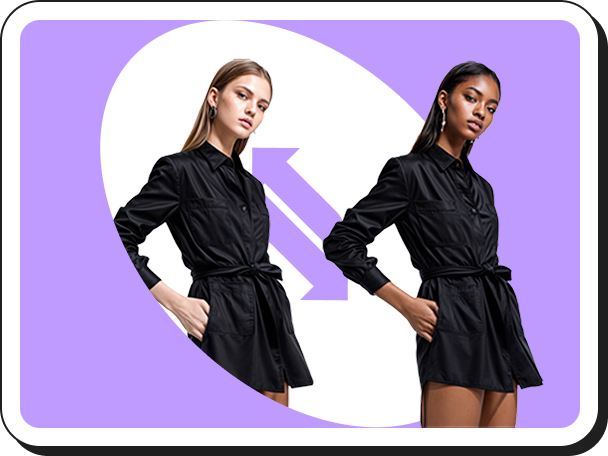
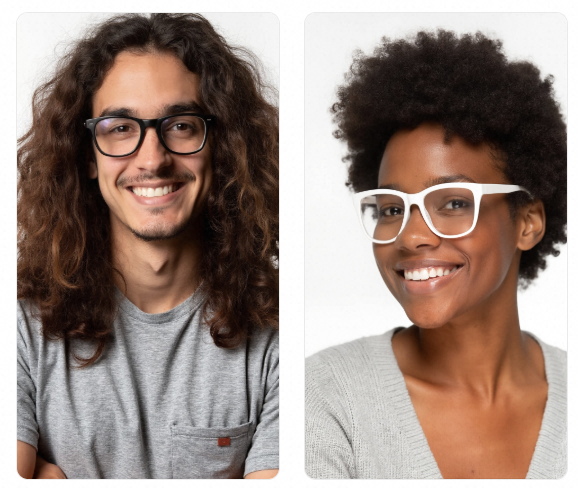
- The AI Solution: You can take Product A and generate it on a Japanese model for your Tokyo ads, a Nigerian model for your Lagos ads, and a French model for your Paris ads.
- The Result: You create a personalized shopping experience for every region without shipping samples around the world.
2. A/B Testing Creatives
Marketing is data-driven. AI allows you to test variables scientifically.
- Hypothesis: Do my "Blue Light Glasses" sell better with a corporate office background or a cozy home-library background?
- Test: Generate both versions in minutes. Run Facebook Ads. Measure the Click-Through Rate (CTR).
- Win: Scale the winner.
3. Rapid Catalog Expansion
Dropshippers often test hundreds of products. Shooting all of them is impossible. With AI, you can test a product's viability by generating high-quality glasses on model images before you even stock the inventory. If the ads convert, you order the stock. This is the ultimate "Lean E-commerce" model.
Section 5: Step-by-Step Workflow for Merchants
Ready to implement this? Here is the standard operating procedure (SOP) for creating professional AI images.
Step 1: The Source Image
The quality of your input dictates the quality of your output.
- Photograph your glasses on a white or transparent background.
- Ensure the angle is straight-on (front view) or slightly angled (3/4 view).
- Pro Tip: Wipe the frames! AI is high-definition; it will capture fingerprints or dust on the lens.
Step 2: Choose Your Virtual Model
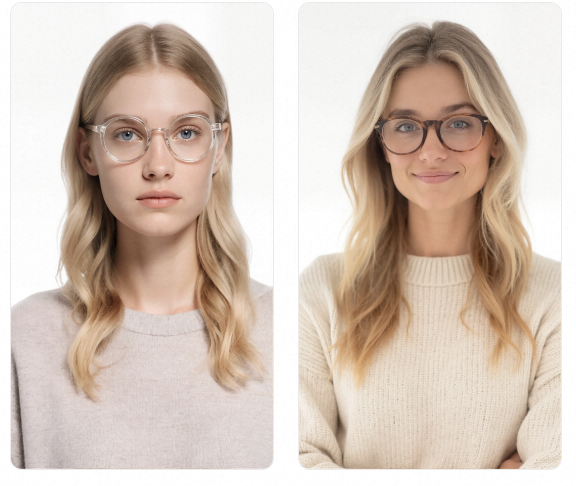
Log into your AI eyewear photography tool. Filter the library based on your brand persona.
- Luxury Brand? Choose models with high cheekbones and serious expressions.
- Lifestyle Brand? Choose models with smiles and casual styling.
- Children's Eyewear? Select age-appropriate kid models.
Step 3: Adjust and Generate
Upload your product. The system will auto-align the glasses to the model's eyes.
- Use the "Scale" tool to ensure the fit is realistic (not too wide, not too narrow).
- Adjust the "Vertical Position" so the pupil is centered in the lens.
- Click Generate.
Step 4: Review and Export
Zoom in on the high-res output. Check the temple tips and the nose pads. If satisfied, download the image. It is now ready for your website banner, email newsletter, or social media feed.
Section 6: Frequently Asked Questions (FAQ)
Q1: Do I own the copyright to these AI-generated images?
In most commercial AI tools, yes. Once you pay for the subscription or credits, you have full commercial rights to use the images for advertising, packaging, and web design. You do not need to pay royalties to the "model" because the model does not exist.
Q2: Can AI handle sunglasses and optical frames differently?
Yes. High-end tools allow you to control Lens Opacity.
- For Sunglasses: Set opacity to 80-90% and add a dark tint.
- For Optical Frames: Set opacity to 0-10% to show the eyes clearly.
Q3: Will customers feel deceived?
Transparency is key. We recommend labeling images as "AI Visualization" or simply ensuring the product itself is accurate. Customers care about the look and fit. As long as the physical glasses they receive match the shape and color in the photo, customer satisfaction remains high. In fact, seeing the glasses on a face (even a virtual one) reduces return rates compared to no model at all.
Conclusion: The Future is Static, Not Virtual
The term "Virtual Try-On" has confused the market for too long. For e-commerce brands, the future isn't about live video feeds or VR headsets. It is about Virtual Production.
By embracing AI glasses on model generation, you are not just saving money; you are gaining agility. You are freeing your brand from the constraints of physical geography and logistics.
The studio of the future is in the cloud. It is open 24/7, has infinite models, and costs less than a lunch.
Ready to transform your product photography?
Stop searching for "VR" and start creating. Upload your first product to our [AI Eyewear Model Generator] and see the difference today.